Saturday, May 1, 2021

Fear


Fear is a very important feeling. In the natural world fear stops animals from getting in harm's way. For example, the fear of fire stops us from getting too close to a lit barbeque. Many years ago,  parents used to tell their children stories about all sorts of monsters, for example, to stop their children from getting too close to the river or to a well. Il-Belliegħa and the Kelpies are still talked about today.

If you want to learn more about Maltese folklore and its monsters, this is the book for you.

It's very important to talk about what scares us. It's also very important that we do not diminish other people's fears, or make fun of their feelings.

Sometimes a bad day, or a bad night, become worse because of fear that our minds exaggerate.
Something this scary becomes THIS SCARY in our minds.


Some fears become too big and stop us from living our lives to the full. Some fears even cause anxiety, which sometimes makes us feel panic, or feel helpless, even giving us tummy aches. 


Here are some things we can do.

1. Talk about it, then talk about yourself.


2. Tell yourself what good qualities you have. Things you could not do before but you can do now. Write them on pieces of paper and put them in a courage jar. Whenever you feel scared, open the jar and remind yourself how fierce and powerful you are.


3. Draw your fear in pencil. Now, get your best glitter stickers, your crayons and stuff to decorate it. Put your fear in a diaper, draw spots on it, put glitter on it, draw lipstick and put a bow on its head. Who is that scary now?


4. Hello, how are you? 
Get to know your fear slowly. If you are afraid of the dark, try spending 30 seconds a night in the dark, if you do well, try increasing the time by 10 seconds, every time. If you are afraid of going to the bathroom alone, try going alone with an adult following you further back. If you are afraid of a food item, smell it, feel it, look at its colours and textures. You might find that you might like it after all. You will also find that under your bed there is only dust and lonely socks, there are no monsters in the closet, nothing is lurking in the bathroom.

5. Use your magic teddy. We all have a magic teddy. Ask people who love you to give your teddy a big hug. Their love goes in the teddy, teddy keeps it safe. When you go to bed, you hug your teddy and feel the love of the people who love you keeping you safe and less afraid.

Deep breaths.
You got this.
We believe in you.

Ms Claudine and Ms Claudette.

Wednesday, February 19, 2020

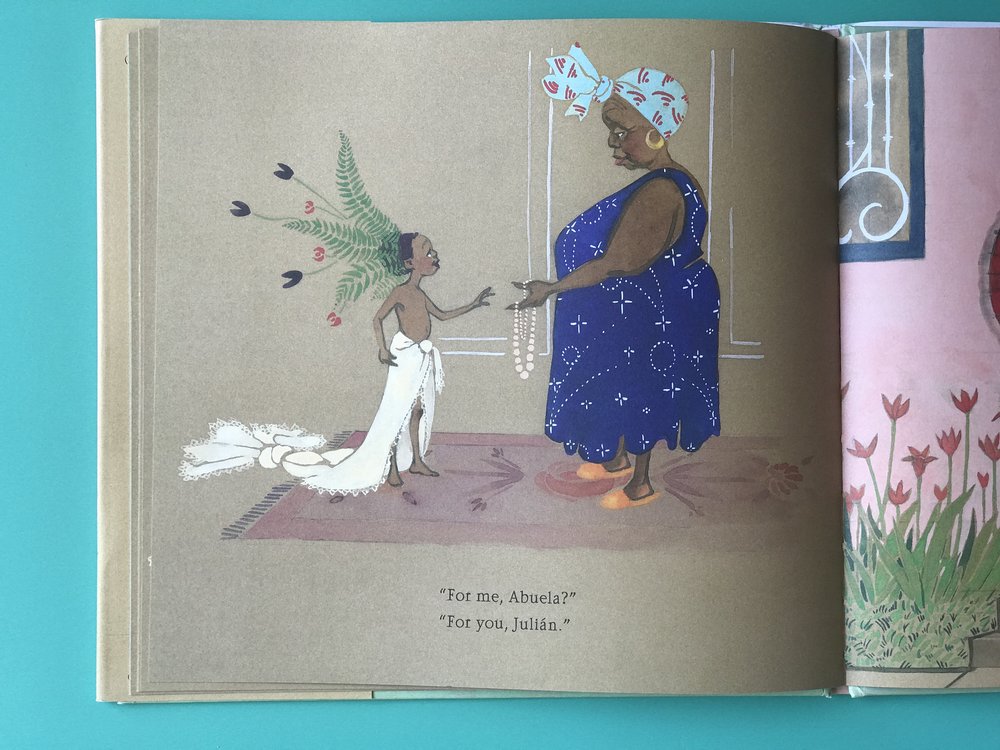
Book Recommendation: Julian is a Mermaid by Jessica Love.


Julian is a boy who lives in New York with his nanna, who he sometimes calls abuela (grandmother in Spanish, as all you Dora fans know). While Julian was on the train with his grandmother, he sees three beautiful ladies dressed up as mermaids. 

Julian loves mermaids, and like all kids do when the train starts rocking, he starts to daydream, imagining himself changing into a mermaid, swimming under the sea and meeting all sorts of wonderful sea creatures.

As they get to their stop, Julian and abuela get off the train. The mermaids wave goodbye to Julian. As they get home, Julian tells his nanna that he is a mermaid too. Nanna says nothing but goes to have a bath. While grandma is relaxing in the bath, Julian goes into her things and becomes a mermaid. 

Nanna comes out of the bathroom, and stares at Julian.
At this point there is tension, the reader does not know what nanna will do…will she freak out? Will she stop talking to Julian? But abuela puts on a beautiful blue dress, gives Julian a string of pearls and takes him to the Annual Mermaid Parade (a real event that happens in Brooklyn, NY)

There are only around ten sentences in this book. The illustrations speak for themselves. They convey a very emotional message. I cried on my first read. 

So many Julians, yet so few abuelas. 


This book teaches acceptance, love and self-love, being who you want to be, even if it’s a mermaid. It teaches children to love who they are, challenging gender stereotypes along the way. Boys can be boys and be mermaids too. That’s ok. Unlike other stories the boy does not have to face criticism or bullying for his choice of play. There is no bullying involved in this story.

 I would dare to think that Julian goes to a good school where bullies are the ones going to counselling and therapy, not the children who choose different toys from the majority. 
This story teaches us how things should be. 
Comfortable in our own skin, comfortable with the skin of those we love, and all those around us. 

I highly recommend this book to anybody raising children, mermaids and unicorns. There is a lot adults can learn from a children’s book, and this is one of those books.

Wednesday, January 22, 2020

For Children aged 3-99.


Why you should play more with LEGO.

a) When you play with small bricks, you are training the little muscles in your fingers and hands. This is called your fine motor control. Having good fine motor control makes your colouring and your handwriting better.

b) Let your imagination run loose with your friends. When you build your houses, castles, volcanos, ancient temples, garages, ships, you are making up stories in your head, you become the creator. You will learn how to play with others, to collaborate and make something together. It is very much like writing a story with a good friend. Or maybe another boy or girl who will become your good friend. How good is that? 

c) That feeling you get when you finish a piece. The feeling of ‘YAY, I made this!’ A very happy feeling that makes you feel good about yourself.

d) Playing with LEGO teaches you resilience. You have to have patience, you need to look for the right brick, and you will make mistakes, so you will go back and fix that little error.
e) You develop a skill for problem solving. A mass of differently coloured and differently shaped bricks turn into an object or an animal. Making sense of a chaos of coloured bricks is like solving a puzzle.

f) LEGO keeps you calmer. Just like when you play Jenga, you need to have calm hands so that none of the bricks get lost.
f) STEAM. Science, technology, engineering, art, mathematics. You have it all in one special box.
Next time you write that letter to Santa, make sure you include the best four letter word there is: LEGO. 


Until then, you can come up to our class and take part in LEGO club.

Monday, June 17, 2019

For the grown ups: How to Deal with Mean People.

1. You cannot control their meanness, but you can control how you react. Try to respond by being nice to them.
2. Compassion. It's hard but do try and have compassion towards the person behaving in a mean way. They might be dealing with difficult issues in their life. 
3. Sometimes the mean person does not respond to your compassion. Make it clear that you will not be walked over. 
4. Notice how the person is making you feel. Are they behaving this way just with you, or with others too? 
5. Take care of yourself. If you are hurt, do something that makes you feel better. 
6. Use breathing techniques to calm yourself down. 
7.Speak with the other person. Tell them how you are feeling. Offer a solution.
8. Escalate the problem to somebody older, or higher in position than yourself or the person who is hurting you. 
9. If nothing works, treat the other person civilly, but reduce the amount of time you have to spend with them.
10. Avoid the person when possible. If you have to spend time with that person, always have an exit plan. While you are in their presence, practice patience and compassion.
11. Find a group of kind, non-gossiping, fun people to spend your time with. The world is full of good people, surround yourself in light. 

Friday, May 31, 2019

We are all different

We are all different. 
What makes us different
Our hair colour, our eye colour, our skin colour, our height, type of family, the shape of our bodies, the things we like. 
We also have qualities that make us special. 
Things that we have that no one else has. 
Things we can do that no one else can do.

Some people bully others for being different.
They do this because they feel bad about themselves, maybe they don't have friends, or they feel they are not very good at doing things. 

People might bully over many things such as 
gender, race and disability. 

We all have the right to be happy. 
We all have the right to feel safe. 
We also have the responsibility to be good people, to do good things and to be kind to everybody. 


Friday, May 24, 2019

I can concentrate

Do you ever find concentrating hard? 

Well, concentration is hard. To concentrate well you need to use many different parts of your body. 

Concentration also needs practise, just like a muscle you train daily.

Do one thing at a time. 

You can't do your homework while you are eating and watching TV at the same time!

Make sure your work-space is clear from clutter. 
This is not a good place to study. 


This is a good place to study. 

Give yourself frequent breaks. 
Use a timer. Take a ten minute break and go back to your work.

Is your HW load too big? Break it down into small tasks. 
Small task, done. Small task, done. Small task, done. 
Soon you will reach your goal.

Give yourself time to sit in silence. 
 
Sit anywhere, with your back straight. 
Choose two of these. 
Notice any smells. 
Notice how your clothes feel. 
Notice the taste inside your mouth. 
Notice the colours and patterns you see when your eyes are closed. 
Listen to the sounds of your body.
Can you feel your heart? Can you hear yourself breathe? 
Breathe in and out slowly. 
Open your eyes. 
Do the same again tomorrow. 


Friday, May 17, 2019

Good Manners

How do you like to be treated? 
Do you like people respecting you? 
Do you like people treating you with kindness? 

Other people would like the same from you too. 
We treat others how we would like to be treated. 
This is The Golden Rule. 

Good manners help us practise The Golden Rule. 

Here are some good manners. 


Wednesday, May 8, 2019

Do not bottle up!

Imagine you are a bottle of cola

Whenever something annoying or bad happens to you,  you are given a shake. 


A friend stops speaking to me - Shake!

I forget to put on my PE kit this morning - Shake!

My grandmother is very sick - Shake!

My dad wants to give our pet dog away - Shake!

I left my homework copybooks at home - Shake!

Dinner is the food I don't like most - Shake!

I accidentally spill a glass of milk on my favourite football t-shirt! - Shake!

The next day, my best friend accidentally hits me. 

BOOM! Explosion!

I scream, yell and cry. 

It was the last straw. 

The bottle of cola exploded. 


That is what usually happens when we bottle up. 

How not to explode? Well, you have to do things to make the bubbles go down after each shake. 

Talk to someone, write about it, do things that calm you down or make you feel happy, fix the problem if you can. 

Whatever you do, do not bottle up. 

Monday, April 29, 2019

You can't always get what you want

Sometimes we ask grown ups to give us something and the answer is NO. 

Our adults have very good reasons why they say NO to us. 

Sometimes it could be because the thing we ask for is too expensive. 

Mum can you buy me a PlayStation 4? 

NO!

Sometimes it could be because the thing is not good for us. 

Mum can you buy me an 18+ computer game? 

NO!

Sometimes it could be because it goes against the values and laws of our society.

Mum can I sit on your lap while you drive? 

No, you can't. 

Sometimes adults explain to us why they say no, and sometimes they don't. 

You can't always get what you want. 
You will not always get what you want. 
You shouldn't always get what you want. 

Being told NO isn't always fun. 

You have to find ways to handle being told NO. 

You can throw a tantrum, yell at the top of your voice and call your grown ups names. Some grown- ups give in to tantrums, but they are not doing you any good by doing so. 
Grown-ups learn self-respect when they say no and mean it. 


Many grown-ups will not give in because they want to raise you as a good person. 
You accept that life is made from being told yes and no for different things, at different times, for different reasons. 
And that's OK.  


Friday, April 19, 2019

Respect

Respect is treating other people the way you would like to be treated. 
Many people in the world call this 'The Golden Rule'.
When teaching respect, it is important to teach children that respect is speaking nicely, listening, being  honest, being responsible, honest, helpful and polite
The most important thing, though, is to model respect

Adults must show respect to each other so that children will know what it feels like to be around people who respect each other. 
Respect is not only shown to other people but also to the environment, animals, other people's property. 
Here is what we do in our respect lesson.


Wednesday, April 17, 2019

The Present

Imagine a puppy teaching you resilience. 
 A disabled boy spends his day playing violent games in a dark room. 
His mother brings him a present. 
Watch the rest here : 


Thoughts from our children:
The little puppy played around and whenever he stumbled he got up again. 
The little puppy did not give up on the boy when he tossed him away. He kept on pursuing him until he gave in. 
The puppy taught the boy a new side to life, being outside in the garden, in the sun, and throwing a ball instead of throwing weapons in a computer game. 
Puppy has three legs, but he still plays around as if he has four. He shows the boy that you can still be happy and live life to the full even if you face difficulties in life. 

Here is the original comic strip on which the animated short was based.  Click on the picture so you can enlarge it. 


Meet Mike

What does a speaker do when they want everybody to listen to them? 
They hold a mike!


Well we don't have just any ordinary mike, we have The Mike. Mike Wazowski. When we hold Mike, everybody stops talking and listens to us. Mike comes to table with us during Circle Time.

Tuesday, April 16, 2019

Inclusion


Everyone is different.
Some children are short; some are tall.
Some are good at sports; others do great in Maths.
Even twins are not exactly the same.

We only have one thing in common;
Feelings

Treat everyone the same as you want them to treat you. Love everyone, help everyone, respect everyone.


Friday, April 12, 2019

Teamwork

Together we are strong, and that is why being part of a team is very important.
To work in a team, we need to:


  • Listen carefully to what everyone has to say
  • Speak up if you disagree
  • Be respectful
  • Do your share of the work


Remember: A stick breaks if it is alone. In a bundle, it will not. Just like the sticks in these photos.

Thursday, April 11, 2019

Positive Discipline: How to apologise.

In our school, we practise positive discipline. We prefer you to make amends and fix your mistakes rather than put you in punishment. 

Here are things you can do when you break the rules. 

a) Say sorry

I'm sorry, I was wrong. Please forgive me. 

b) Fix the damage. 
Did you break a toy? Replace it. 
Did you scribble on the wall? Clean it. 
Did you hurt someone? Make up for it by helping them.

c) You can write it down. 

d) You can do a gesture that makes the other person feel better.
Whatever you do, do not be afraid to say sorry. 


Wednesday, April 10, 2019

How big is your problem?

This week we are doing lessons on resilience. 
Sometimes we need to put our problems into perspective. 
How big is a problem, really? 
We invented a problem scale. Each child had a set of five lollies with numbers on them.

Problem number 1: A glitch, something that usually solves itself. 
Problem number 2: A small problem which you can solve yourself. 
Problem number 3: A problem for which you need some help from others. 
Problem number 4: A problem for which you need a lot of help. 
Problem number 5: An emergency. Something that can be helped with some difficulty, if at all. Sometimes we need to learn to live with a number 5. 

We read a lot of different scenarios, and discussed how big each problem is. Dealing with the small problems ourselves helps us face the bigger problems better. That is resilience. 

Resilience

This week we taught hard about teaching a new word to our children, but as always, they surprised us. They learnt what resilience is fast, and many of them showed strong traits of resilience themselves. We tried to demonstrate this by getting the children to build a large tower made of paper cups. They had to work together, work gently and whenever the tower accidentally fell down, they had to start over again. Giving up was not an option, but finding solutions on how to make the tower not fall down was the rule of the game. 
Here are two photos from this lesson. 


Wednesday, April 3, 2019

Qualities of a good friend

We are all different and we all have different good qualities. That's why we can be close friends with some children and not with others, because we look for different things in different people. 

What do you look for in a friend? 
Here is the worksheet we put in our journal this week.


Wednesday, March 27, 2019

Giving Compliments

One thing that friends do is compliment each other. 
Sometimes we find it easier to find what's wrong in other people than to compliment them. 
Giving a compliment is an easy way to start a conversation with someone. 
Here are some ideas that came out during one of our lessons.
Children wrote or drew compliments for each other on each other's journals.

Wednesday, March 20, 2019

Kind and Unkind

Here is what we learnt today. 
Sharing, playing with others, being polite, smiling, helping, being there for a friend who is sad are all kind things. 


Search This Blog