Saturday, May 11, 2013

Tuesday, May 7, 2013

Sunday, May 5, 2013

Superpower Podcasts : Journal

As you know, every few days we do a journalling session. The pupils love this and so do I. They get to watch a video, a picture, hear a song, and write something about it...anything.
Some children get recorded. 
This week we saw a video about a Superhero.


Monday, April 29, 2013

What a great day today was!

I hope we'll have more of these, more often. Thank-you for being so well behaved and for enjoying our lessons. 

So today we learnt (and I hope I can do this more often) :

a) About the day Jesus said goodbye to his friends. 
b) About quarter past and quarter to. 
c) We read a new book 'Ir-Razzett tan-Nannu Turu', which has great illustrations. 
d) We learnt about Animal Families in Maltese.
e) We learnt about the life cycle of the frog and about frog anatomy. 
We came across this funny video too
f) We giggled a lot and argued very little. 

Miss Claudine is a happy teacher today. 

Sunday, April 28, 2013

Three...two...one

Three... two... one.... Less than two weeks ago, SpaceX became the first privately held company to send a spacecraft to the International Space Station, located 240 miles above the Earth. The unmanned capsule—named Dragon, and carried by the Falcon 9 rocket—took off on May 22nd from Cape Canaveral in Florida, arrived at the space station on the 25th, and landed in the Pacific Ocean on the 31st before heading back to Los Angeles via barge this past Tuesday, June 5 (Makes a cross-country drive seem like a very short trip).


About space

Did you know that space is known as The Great Unknown? That’s a fact! And did you know it’s referred to as such because the universe is so vast that humans can only ever hope to unearth a fraction of its mysteries? That’s a pun! But did you also know that the fraction we do understand is often times totally wrong? That’s what this article is about!

Saturday, April 27, 2013

Jupiter


Jupiter's appearance is a tapestry of beautiful colors and atmospheric features. Most visible clouds are composed of ammonia. Water vapor exists deep below and can sometimes be seen through clear spots in the clouds. The planet's "stripes" are dark belts and light zones created by strong east-west winds in Jupiter's upper atmosphere.
A true-color image of Jupiter taken by the Cassini spacecraft. The Galilean moon Europa casts a shadow on the planet's cloud tops.

The moon

Our Moon makes Earth a more livable planet by moderating our home planet's wobble on its axis, leading to a relatively stable climate, and creating a rhythm that has guided humans for thousands of years. The Moon was likely formed after a Mars-sized body collided with Earth and the debris formed into the most prominent feature in our night sky.


Color image of the full disk of the Moon.


A treat for my budding astronauts.

Seeing so many posts about space, here's a slide show you will enjoy :)

http://www.sparknotes.com/mindhut/2013/04/23/the-top-10-coolest-astronauts-ever/slide/11

Our planet

Today i did this on purplemash of planets

Jellyfish


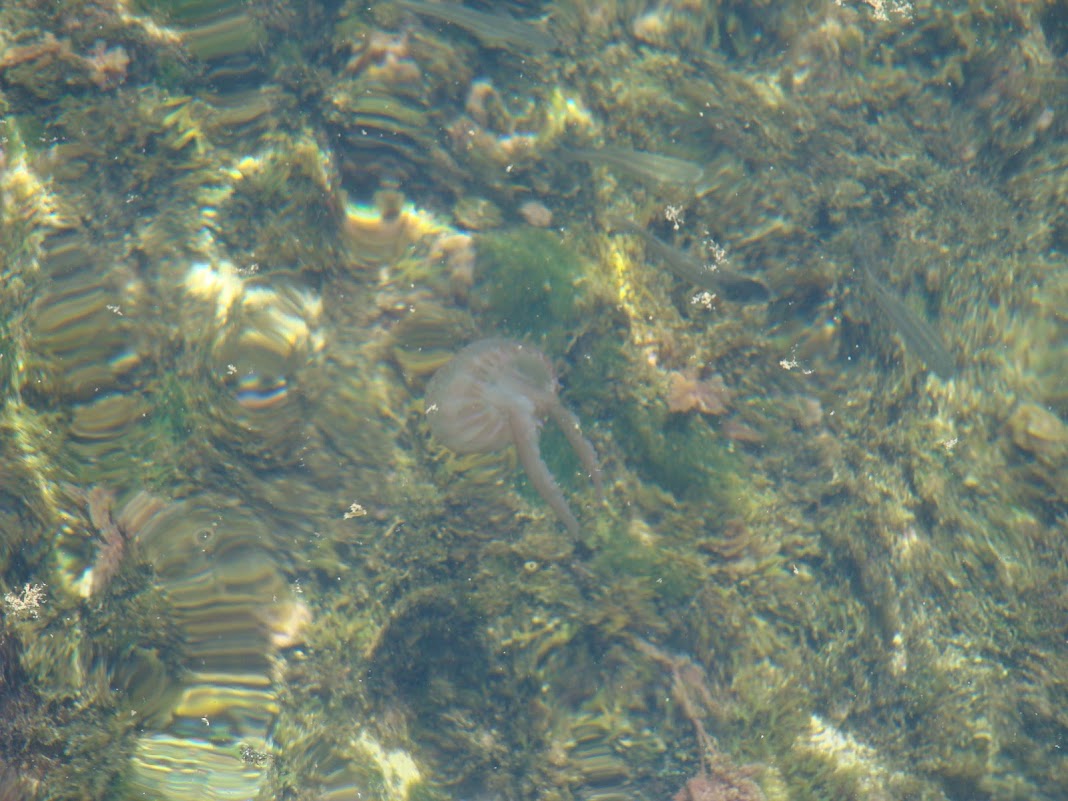
This is a picture of a jellyfish in the water


Snow Monkey

Snow monkeys are famous for their intelligence and social behavior. They use tools,wash their food, and have a complex system of communication

Jupiter

Jupiter, the most massive planet in our solar system -- with dozens of moons and an enormous magnetic field forms a kind of miniature solar system. Jupiter does resemble a star in composition, but it did not grow big enough to ignite. The planet's swirling cloud stripes are punctuated by massive storms such as the Great Red Spot, which has raged for hundre of years.

A true-color image of Jupiter taken by the Cassini spacecraft. The Galilean moon Europa casts a shadow on the planet's cloud tops.

Uranus

Uranus is the only giant planet whose equator is nearly at right angles to its orbit. A collision with an Earth-sized object may explain Uranus' unique tilt. Nearly a twin in size to Neptune, Uranus has more methane in its mainly hydrogen and helium atmosphere than Jupiter or Saturn. Methane gives Uranus its blue tint.

The sun

The sun is a star, a hot ball of glowing gases at the heart of our solar system. Its influence extends far beyond the orbits of distant Neptune and Pluto. Without the sun's intense energy and heat, there would be no life on Earth. And though it is special to us, there are billions of stars like our sun scattered across the Milky Way galaxy

Color image of the sun.

Men on the Moon

The first men to land on the Moon were Neil Armstrong and Buzz Aldrin in July 1968. The most recent was Eugene Cernan in December 1972.

Search This Blog